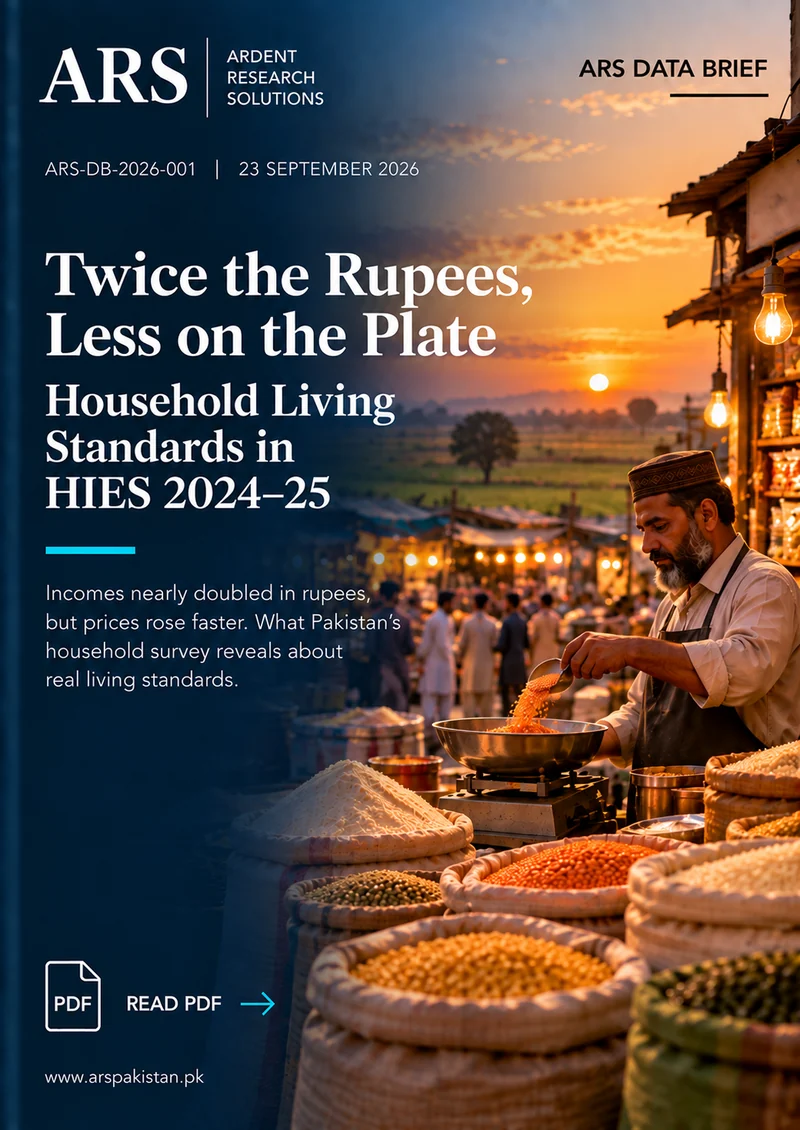
Twice the Rupees, Less on the Plate: Household Living Standards in HIES 2024–25
Pakistan’s latest Household Integrated Economic Survey shows average household income almost doubling in rupees between 2018–19 and 2024–25, from Rs 41,545 to Rs 82,179 a month. Prices rose faster. This Data Brief adjusts the survey for inflation and finds that real household income fell by about 12%, the poorest fifth lost about a fifth of its income, and people ate less of almost every staple food the survey measures.
Summary
The Household Integrated Economic Survey (HIES) 2024–25 is the Pakistan Bureau of Statistics’ first fully digital household survey, covering about 32,800 households between September 2024 and June 2025. PBS reports income and spending in current rupees, so its headline comparisons with the previous round, 2018–19, are not adjusted for inflation. This Data Brief adjusts them using the national Consumer Price Index, which rose by 125.3% between the two survey years.
On that basis, the six years brought no gain in living standards for the average Pakistani and a clear loss for the poorest. Real household income fell, real spending per person was roughly flat, the gap between the richest and poorest households widened, and the physical quantities of food people ate fell for 13 of the 14 staples the survey tracks. Households are leaning more on remittances and assistance, including BISP, to cover the gap.
Key findings
- Incomes doubled in rupees, but prices more than doubled. Average monthly household income rose 98%, from Rs 41,545 to Rs 82,179, while consumer prices rose 125%. After inflation, household income fell by about 12% and household consumption by about 5%.
- Living standards per person stood still. Households became smaller and had fewer earners. Real income per person fell by about 8% and real consumption per person by about 1%.
- The poorest lost the most. The poorest fifth of the population lost about 20% of its real income, the richest fifth about 3%. The richest fifth was the only group whose real consumption rose, and the income gap between them widened from 2.74 to 3.33 times.
- People ate less. Per person, monthly consumption of pulses fell 26%, rice 19%, milk 10%, eggs 7% and wheat flour 6%. Only tomatoes rose.
- Budgets were squeezed. Education fell from 3.98% to 2.48% of household spending, while housing, water, electricity and fuel rose from 23.76% to 25.72%.
- Transfers matter more. Foreign remittances rose from 4.96% to 7.77% of household income, and gifts and assistance, which include BISP, from 2.12% to 4.57%.
What the numbers mean
In ARS’s assessment, headline nominal figures are misleading in a period of high inflation, and PBS could publish inflation-adjusted series alongside current-price figures as standard practice. The losses fell hardest on the households least able to absorb them, and falling consumption of pulses, milk and eggs raises nutritional concerns that income averages do not capture. Social protection and food policy should be designed around real purchasing power, not nominal transfer values.
Households are also relying more on remittances and assistance, support that depends on conditions abroad and on the fiscal space available for BISP. The survey’s fieldwork ended in June 2025, before the recovery of FY2026; the next HIES round will show whether that recovery has reached household budgets.
Inside the Data Brief
- Key numbers and key findings
- About the data
- Incomes doubled. Prices more than doubled.
- The bottom lost the most
- Less on the plate
- Households are leaning on transfers
- What the numbers mean
- Data notes, references and about the author
About the author
How to cite
Khan, R. (2026). Twice the Rupees, Less on the Plate: Household Living Standards in HIES 2024–25. Ardent Research Solutions. https://arspakistan.pk/data-briefs/household-living-standards.html
Related research
This summary is drawn from the full publication, which should be read for the sources, qualifications and method behind each finding. HIES figures are Pakistan Bureau of Statistics estimates; inflation-adjusted changes are ARS calculations. It reflects the views of the author and not necessarily those of ARS or its affiliates.