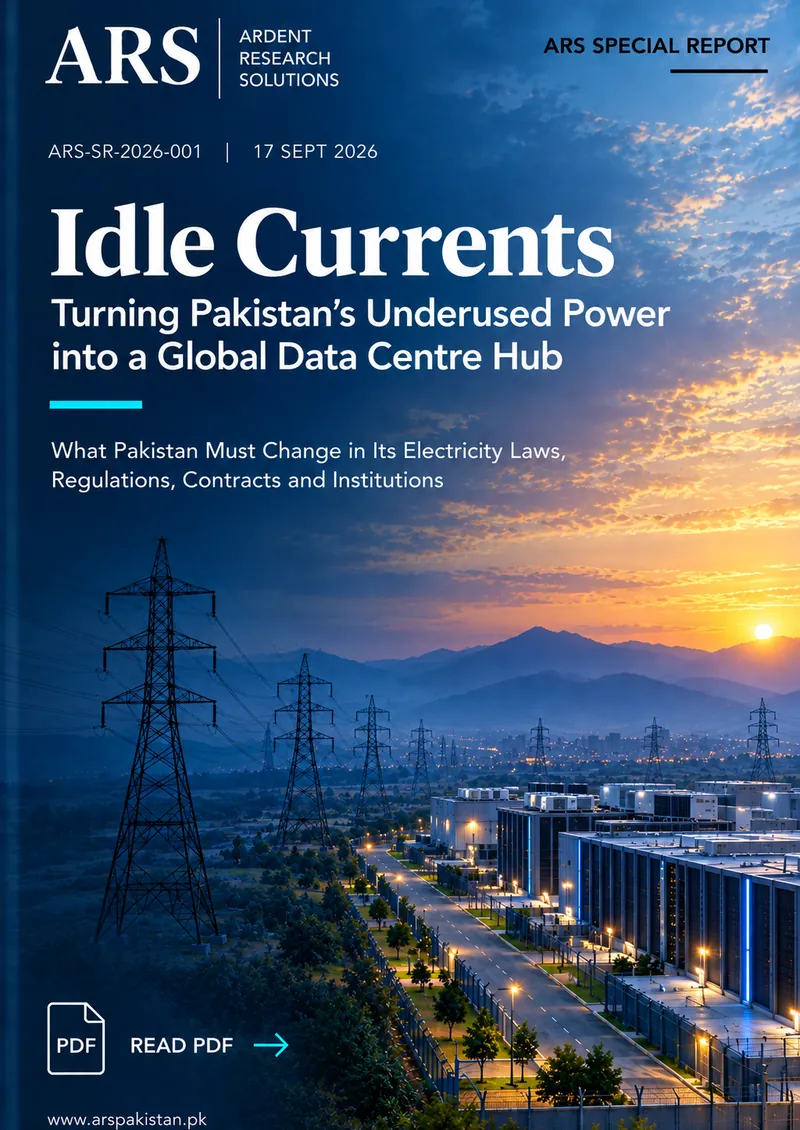
Idle Currents: Turning Pakistan’s Underused Power into a Global Data Centre Hub
This report examines whether Pakistan can turn its underused electricity generating capacity into a foundation for a globally competitive data centre industry. It examines the economic, legal, regulatory and contractual barriers that currently prevent large data centres from operating out of Pakistan. It analyses Pakistan’s power system, captive and hydropower options, data centre power requirements, electricity procurement structures and the existing NEPRA framework, before proposing a legal and contractual reform model designed to make such projects bankable. The report also considers potential locations, economics, implementation and the risk of creating new stranded assets.
Summary
Pakistan pays for a power system far larger than the load it serves. It closed FY 2024-25 with 41,121 MW of installed generation capacity against an average load of roughly 15,400 MW, and capacity charges make up about 63% of the power purchase price determined for FY 2025-26. This report asks whether that underused capacity can be turned into globally traded computing capacity by supplying hyperscale data centres, and what would have to change in Pakistan’s electricity laws, regulations, contracts and institutions first.
It treats the question as a legal and commercial one rather than a promotional one. Electricity is abundant on paper; the right to buy it at a known price, for a known term, with a known remedy if it is not delivered, is not. The report’s central argument is that Pakistan has built a permission architecture where a rights architecture is required, and that permissions cannot be financed.
Key findings
- The surplus is one of capacity, not energy. The plants that sit idle are largely the expensive ones low in the merit order, so idle plant is not cheap power available on demand.
- The opportunity lies in contract restructuring rather than new generation: converting a capacity payment that is currently a pure liability into one partly recovered from a new, creditworthy, dollar-earning load.
- Captive generation cannot carry a hyperscale campus alone, and the Off the Grid (Captive Power Plants) Levy Act 2025 has made the gas-fired route substantially worse.
- Hydropower is cheap but seasonal, not firm. WAPDA generated at an average cost of Rs 3.83 per unit in 2025, but its six largest stations ran at 80% of nameplate in August and 12% in January, and the 969 MW Neelum-Jhelum plant is out of service, with WAPDA hoping to restore generation by March 2028.
- The law permits much but guarantees little. Section 22 of the NEPRA Act says the Authority “may permit” sales to bulk power consumers, open access under section 14C is subject to a grid company’s determination, and wheeling charges have moved administratively from above Rs 22 to below Rs 9 per unit.
- Bankability is the binding constraint. On the questions a hyperscaler’s lenders actually ask, Pakistan scores 24 out of 75 today; the reform package set out in the report would take it to 64.
- The prize is real but modest. A 1,000 MW campus contracted at a delivered 8 to 10 US cents would carry between Rs 46 billion and Rs 91 billion a year toward capacity charges, reducing every other consumer’s tariff by Rs 0.36 to Rs 0.72 per unit, with no subsidy and no new generation.
The reform package
The report sets out a division of labour. Parliament creates the legal right, through a new section 22A, amendments to sections 14C(2) and 27 of the NEPRA Act and completion of the personal data protection legislation. NEPRA writes the rules: eligibility regulations, a binding long-term tariff and use of system methodology, replacement wheeling regulations, a standby and replacement power product and approved standard contracts. The market operator publishes access procedures, a transmission capacity register, a curtailment ranking with defined compensation and settlement rules able to match a flat load to a seasonal generator.
The grid makes the right physically deliverable, six interlocking contracts make it bankable, and government makes sites investable through zone designation, single-window permitting, a cross-border data transfer position and a State Bank repatriation confirmation. What separates today’s score from the reformed one is not generation capacity, hydrology or global demand, but a set of legal instruments that require a political decision rather than capital.
Inside the report
Part I. Pakistan’s Power Surplus
- Pakistan’s Power Paradox
- The Independent Power Producer Model
Part II. Who Can Supply Power?
- Captive Power: Can Data Centres Do It Alone?
- Hydropower: Pakistan’s Natural Advantage, Correctly Stated
Part III. The Data Centre Opportunity
- Why Data Centres Change the Equation
- What Would Pakistan Actually Be Selling?
- What Would a Pakistani Data Centre Power Deal Look Like?
Part IV. What Can the Law Do Today?
- Pakistan’s Current Electricity Law Framework
- Where the Existing Legal Framework Falls Short
Part V. What Has to Change?
- The Legal Reform Package
- The ARS Proposed Legal Model
- The Bankability Test
- Contracts That Make the Model Bankable
Part VI. Making Data Centres a Reality
- Where Should Pakistan Build?
- What Could the Opportunity Be Worth?
- A Roadmap from Law to Data Centre
- Risks, Limits and the Possibility of New Stranded Assets
The report also includes an executive summary, a conclusion, annexes on the statutory provisions referenced and on definitions and units, and full references.
This is the first report in a continuing ARS series on Pakistan’s digital infrastructure economy.
About the authors
How to cite
Khan, R. and Qureshi, W. A. (2026). Idle Currents: Turning Pakistan’s Underused Power into a Global Data Centre Hub, ARS Special Report ARS-SR-2026-001. Ardent Research Solutions, Islamabad. https://arspakistan.pk/special-reports/idle-currents.html
Related research
This summary is drawn from the full publication, which should be read for the sources, qualifications and method behind each finding. It reflects the views of the authors and not necessarily those of ARS or its affiliates. Nothing in this report constitutes legal advice or a legal opinion.