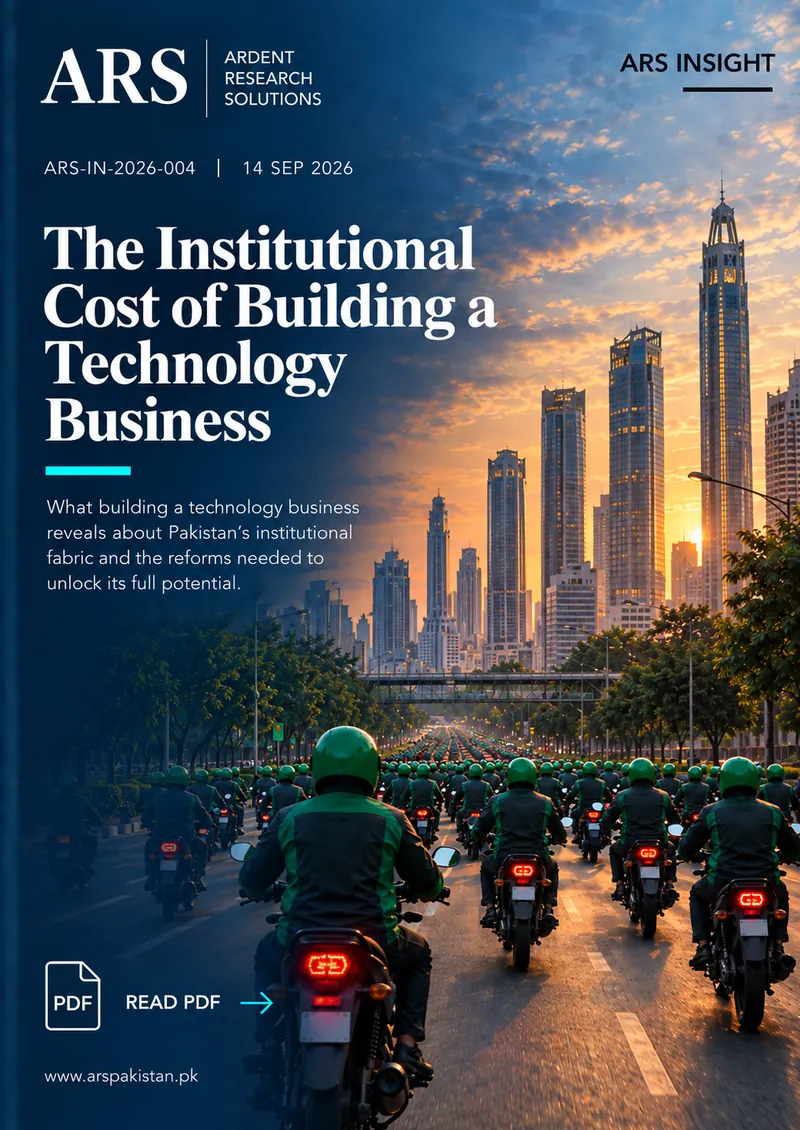
The Institutional Cost of Building a Technology Business
Drawing on the operating experience of a founder who has built a consumer platform at scale in Pakistan, this insight examines what now limits technology businesses: a paying customer base far smaller than the national population suggests, credit that small firms cannot reach, fragmented sectoral rules, and a playing field tilted by uneven tax enforcement, unchecked imports and heavily capitalised foreign entrants.
Summary
Pakistan’s pitch to founders and investors rests on scale: a population approaching 250 million, a technology sector setting export records and a large, competitive freelance workforce. Drawing on the operating experience of a founder who built a consumer platform at scale in Pakistan, this Insight gives a more granular account. Regulators have removed most of the formal barriers that once stood between a technology venture and foreign capital. What now limits a founder is the market itself.
The Insight identifies the constraints that matter: a paying customer base far smaller than the national population suggests, credit that small firms cannot reach, sectoral rules still fragmented across federal and provincial mandates, and a playing field tilted by uneven tax enforcement, unchecked imports and heavily capitalised foreign entrants. It argues that the next round of reform must build the market rather than ease entry into it.
Key findings
- Entry is no longer the binding constraint. Start-ups have been able to raise convertible debt from foreign investors since May 2021, and in May 2026 the State Bank delegated registration of repatriable shares, and remittance of dividends and disinvestment proceeds, to authorised banks.
- Coverage has outpaced use. The GSMA found that 81% of Pakistanis live under mobile broadband coverage and 68% own a smartphone, yet only 29% had used the mobile internet in the previous year.
- Demand has weakened. The World Bank projects that national poverty rose to 25.3% in FY2024, after the pandemic, floods and record inflation eroded the discretionary spending on which consumer platforms depend.
- Credit rarely reaches small firms. Banks hold around 62% of their assets in investments, mostly government securities, and financing to small and medium enterprises was just 7.8% of domestic private sector financing in June 2026.
- Compliance is a competitive disadvantage. Tax revenue reached 12.3% of GDP in FY2025, still below the 25th percentile of peer countries, and over 85% of jobs remain informal, so a firm that documents its sales competes against rivals that do not.
- Pakistan imports staples it could plausibly produce, including USD 3.79 billion of palm oil in FY2026 and, on USDA forecasts, 5.6 million of the 10.6 million bales of cotton its mills will use in 2025/26.
The way forward
The Insight sets four priorities for a domestic market that rewards producing, paying tax and building in Pakistan. First, enforce the tax regime uniformly before extending it, bringing untaxed competitors into the net so that compliant firms are not penalised for complying. Second, curb unnecessary and smuggled imports, particularly in edible oil, cotton and vehicles, through measures that are targeted, time limited and tied to domestic production commitments; the author acknowledges that this prescription is contested, and that the National Tariff Policy 2025-30 moves the other way.
Third, lower the cost of the export leg for small sellers, for example through a time limited rate for small export parcels tied to export volumes. Fourth, make Pakistan easier to reach by restoring a fast, publicly guaranteed visa route for business and tourist travel. The open question, in the author’s words, is whether policymakers will trade some short term consumer prices and tariff revenue for a market in which building for Pakistani customers is a viable business rather than an act of faith.
Inside the Insight
- Context
- Analysis, including imports of staples Pakistan could plausibly produce
- Implications
- The Way Forward
- References
- About the Author
About the author
How to cite
Maayr, M. (2026). The Institutional Cost of Building a Technology Business. Ardent Research Solutions. https://arspakistan.pk/insights/institutional-cost.html
Related research
This summary is drawn from the full publication, which should be read for the sources, qualifications and method behind each finding. It reflects the views of the author and not necessarily those of ARS or its affiliates.