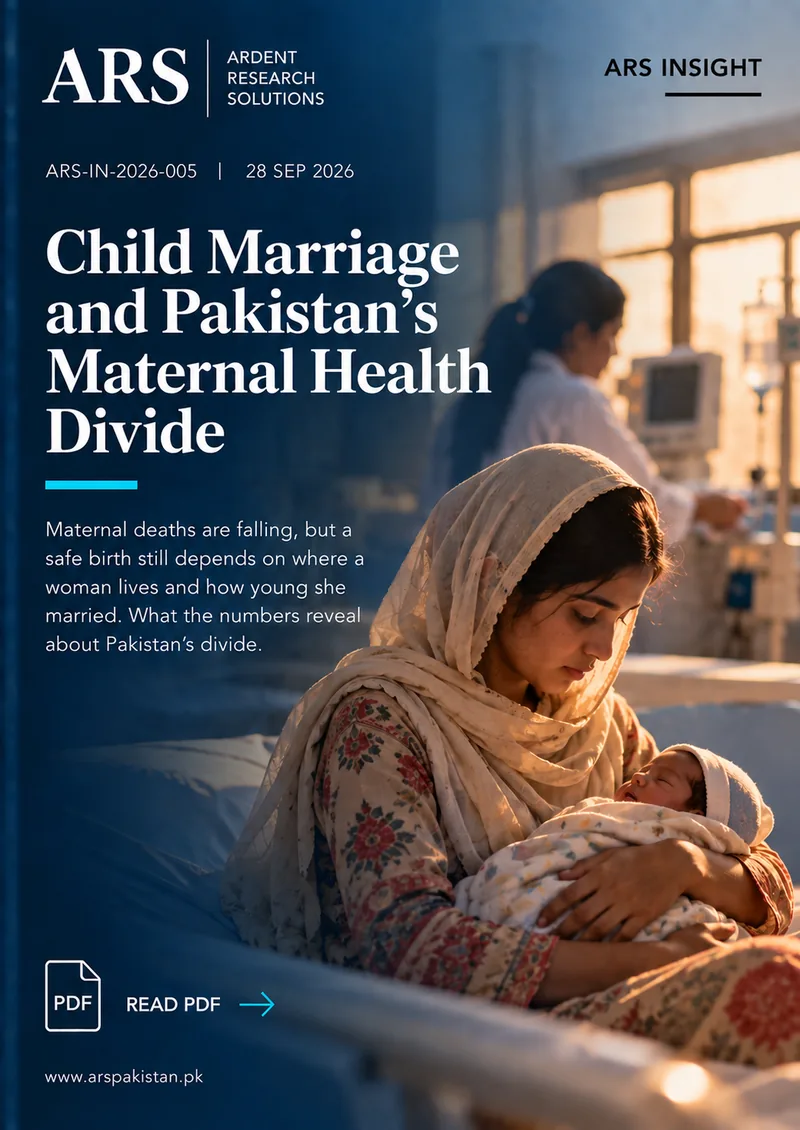
Child Marriage and Pakistan’s Maternal Health Divide
Drawing on more than four decades of medical practice and service on the National Commission on the Rights of Child, this insight argues that Pakistan’s maternal health divide is caused less by a lack of money than by weak governance, and that child marriage lies at the heart of the problem. Many of the mothers most at risk are girls married before 18, whom the state often meets for the first time in a labour ward, where no one is required to record that the patient is a child.
Summary
Pakistan has cut the rate at which women die in childbirth by a third since 2007. Yet a woman’s chance of a safe delivery still depends on where she lives, how poor her family is and how young she was when she married. Writing as a physician with more than 40 years in practice and a former Member of the National Commission on the Rights of Child, the author argues that this divide is a problem of governance more than of resources.
The Insight shows that maternal health and child protection were built as separate systems that have never been required to work together. A pregnant girl of 14 or 15 can pass through a labour ward, where she is almost certain to appear in an official record, without her age triggering any referral, question or protection. With birth registration low and the laws on child marriage enforced mainly through complaints, the state is not counting where child marriage and dangerous pregnancies overlap.
Key findings
- Progress is real but uneven. The maternal mortality ratio fell by 33% between 2007 and 2019, from 276 to 186 deaths per 100,000 live births, and a modelled estimate puts it at 155 in 2023, still above the South Asian average of 120.
- The widest gaps are now between provinces. In 2019 Balochistan recorded 298 maternal deaths per 100,000 live births and Sindh 224, against 165 in Khyber Pakhtunkhwa and 157 in Punjab.
- Contact is not continuity. In 2017-18, 86% of women saw a skilled provider at least once during pregnancy but only 51% had the recommended four or more visits; a skilled attendant was present at 87% of births in Islamabad but only 38% in Balochistan.
- Child marriage follows poverty. In 2018, 18% of women aged 20 to 24 had married before 18, rising to 34% in the poorest families against 7% in the richest; women married as children had more than twice the odds of giving birth at home.
- Adolescent mothers face nearly double the risk. The 2019 survey recorded 194 maternal deaths per 100,000 live births among mothers aged 15 to 19, against 99 among those aged 20 to 24.
- The state cannot see the overlap. Only 42% of children under five had their births registered in 2017-18, ranging from 82% in Islamabad to 19% in Khyber Pakhtunkhwa, and 9% among the poorest fifth of families.
The way forward
The Insight rejects another awareness campaign and sets out three practical administrative changes. First, complete the legal reform: Sindh, Islamabad Capital Territory, Balochistan and Punjab have set the minimum age of marriage at 18, and Khyber Pakhtunkhwa, where girls may still legally marry at 16, should send its draft bill to the cabinet and assembly without further delay, while provinces with new laws publish yearly figures on reported cases and prosecutions.
Second, create a mandatory and protected referral from maternity services to child protection units for girls under 18, written into the standard procedures of Lady Health Workers, community midwives and hospital maternity units, with the aim of protection rather than punishment and with confidentiality safeguarded so that no family is afraid to seek care. Third, make the health system responsible for recording births and marriages, registering births at the facility or during the postnatal visit and linking them to the mother’s age. Closing the gap, the author concludes, will cost less money than most people assume, but will require more institutional honesty than Pakistan has shown so far.
Inside the Insight
- Context, including Table 1 on provincial and urban–rural differences in maternal risk and care
- Analysis
- Implications
- The Way Forward
- References
- About the Author
About the author
How to cite
Fareed, R. (2026). Child Marriage and Pakistan’s Maternal Health Divide. Ardent Research Solutions. https://arspakistan.pk/insights/maternal-health-divide.html
Related research
This summary is drawn from the full publication, which should be read for the sources, qualifications and method behind each finding. It reflects the views of the author and not necessarily those of ARS or its affiliates.