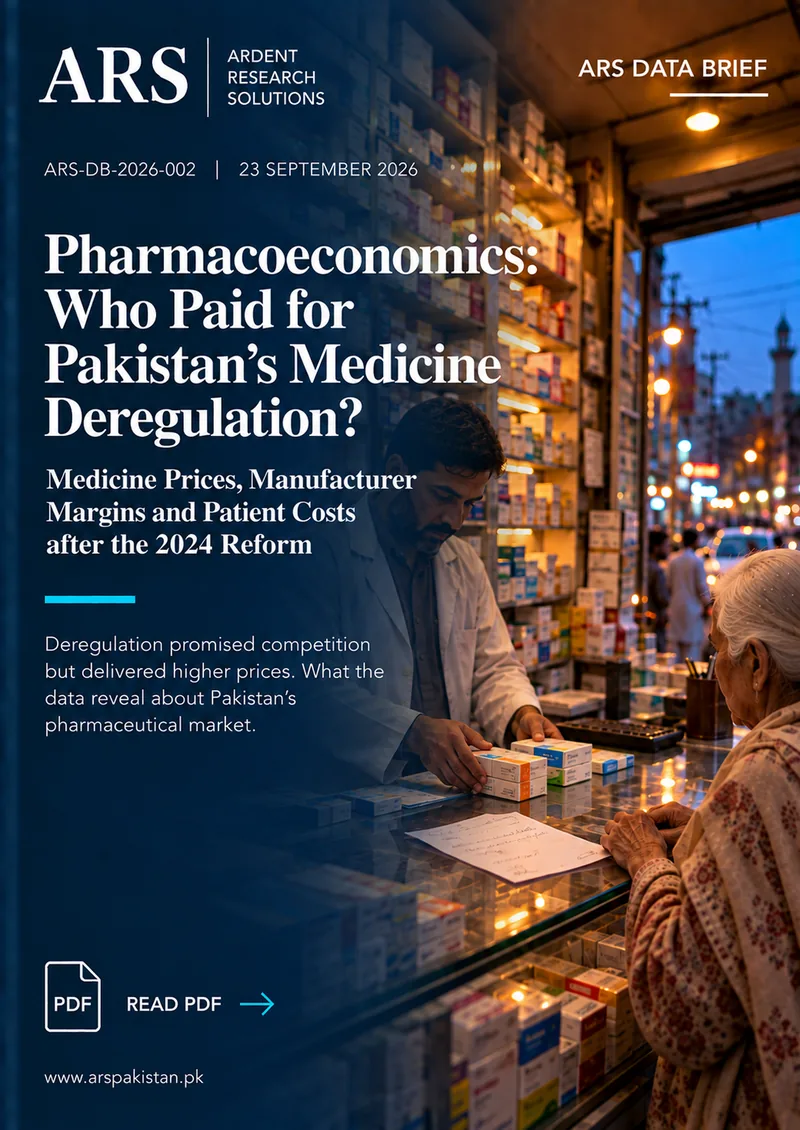
Pharmacoeconomics: Who Paid for Pakistan’s Medicine Deregulation?
In February 2024 Pakistan ended price control on medicines outside its National Essential Medicines List, on the promise that competition would discipline prices. This Data Brief follows the money through official price indices, DRAP’s survey of 771 deregulated brands, pharmacy sales audits, independent price surveys and company accounts. Medicine prices rose by about a third, sales grew mainly because prices rose, and the gross margin of listed manufacturers climbed from 26% to 41% of sales. Patients, who pay more than half of all health spending out of their own pockets, bore the cost.
Summary
In February 2024 the federal government ended price control on medicines that are not on the National Essential Medicines List (NEML). Until then, the Drug Regulatory Authority of Pakistan (DRAP) had fixed the maximum retail price of every registered medicine. The case for the reform was that controlled prices had fallen so far behind costs that medicines were leaving the shelves, and that manufacturers free to set their own prices would compete for buyers.
That second argument assumes that the person who chooses a product also pays for it. In Pakistan’s pharmacy market the doctor chooses the medicine, the patient pays, and no insurer or public purchaser stands between them: households paid 52.9% of all health spending directly in 2023. This Data Brief draws on six independent sources to trace what happened to medicine prices, pharmacy sales, manufacturers’ margins and patients’ costs in the two years after deregulation.
Key findings
- Medicine prices rose sharply after deregulation. The Health Ministry and DRAP put the overall increase at 32%, and 424 of the 771 deregulated brands in DRAP’s own survey were selling above their earlier price. Between February 2024 and February 2026 the CPI index for medicines and medical care rose 22.6%, against 8.6% for all consumer prices.
- Pharmacy sales grew mainly because prices rose. Higher prices explained 69% of the growth in pharmacy sales in the year to March 2025, while the number of packs sold rose by only 3.6%.
- Prices rose most where competition was weakest. Original brands of diabetes tablets rose 47%, against 15% for the cheapest generics; insulins freed from price control rose 37%, against 22% for insulins still controlled.
- Manufacturers’ margins rose well beyond their earlier level. The gross margin of listed drug companies rose from 26% of sales in 2023 to 41% in 2025, while the rupee was stable and imported raw materials became cheaper. About 70% of the rise in gross profit came from higher margins rather than higher sales.
- Patients bore the cost. A common regimen of six medicines for diabetes, blood pressure and cholesterol costs Rs 1,904 more each month when the doctor prescribes original brands rather than the cheapest generics, about 17 days’ wages a year for a low paid worker.
- Shortages persist where prices are still controlled. Essential medicines remain under a formula that allowed an increase of no more than 4.9% in FY2026, and pharmacists reported 105 essential medicines, including oral morphine and several cancer medicines, as unavailable or in short supply in July 2026.
What the numbers mean
A return to blanket price control is not the answer: it caused the shortages that led to deregulation, and the industry’s case that margins had to recover is partly supported by the evidence, since listed companies earned a net margin of 2.9% in 2023. By 2025, however, their gross margin stood 11 percentage points above its 2022 level, and patients paid for that increase.
The brief sets out four remedies that strengthen the buyer’s side of the market: prescribing by generic name, with pharmacists allowed to dispense a generic of assured quality and DRAP enforcing bioequivalence testing; an essential medicines list built around Pakistan’s own disease burden; a pricing rule for controlled medicines that adjusts automatically for input costs; and pooled purchasing or insurance cover for a short list of outpatient medicines for chronic illness. For doctors the implication is immediate, because the prescription largely determines the price a patient pays.
Inside the Data Brief
- Key numbers and key findings
- About the data
- Why deregulation did not create price competition
- Medicine and medical care prices rose faster than other prices
- Most deregulated brands became more expensive
- Sales grew because prices rose, not because more medicines were sold
- Prices rose most where competition was weakest
- The doctor’s choice of brand largely determines the patient’s bill
- Manufacturers’ margins rose well beyond their earlier level
- Households bore the cost
- Shortages persist among essential medicines under price control
- Policy implications
- Data notes, references and about the author
About the author
How to cite
Khan, R. (2026). Pharmacoeconomics: Who Paid for Pakistan’s Medicine Deregulation? Ardent Research Solutions. https://arspakistan.pk/data-briefs/medicine-deregulation.html
Related research
This summary is drawn from the full publication, which should be read for the sources, qualifications and method behind each finding. Prices, sales and company results are taken from the Pakistan Bureau of Statistics, DRAP, IQVIA, Topline Securities and peer reviewed pharmacy surveys; derived changes are the author’s calculations. It reflects the views of the author and not necessarily those of ARS or its affiliates.