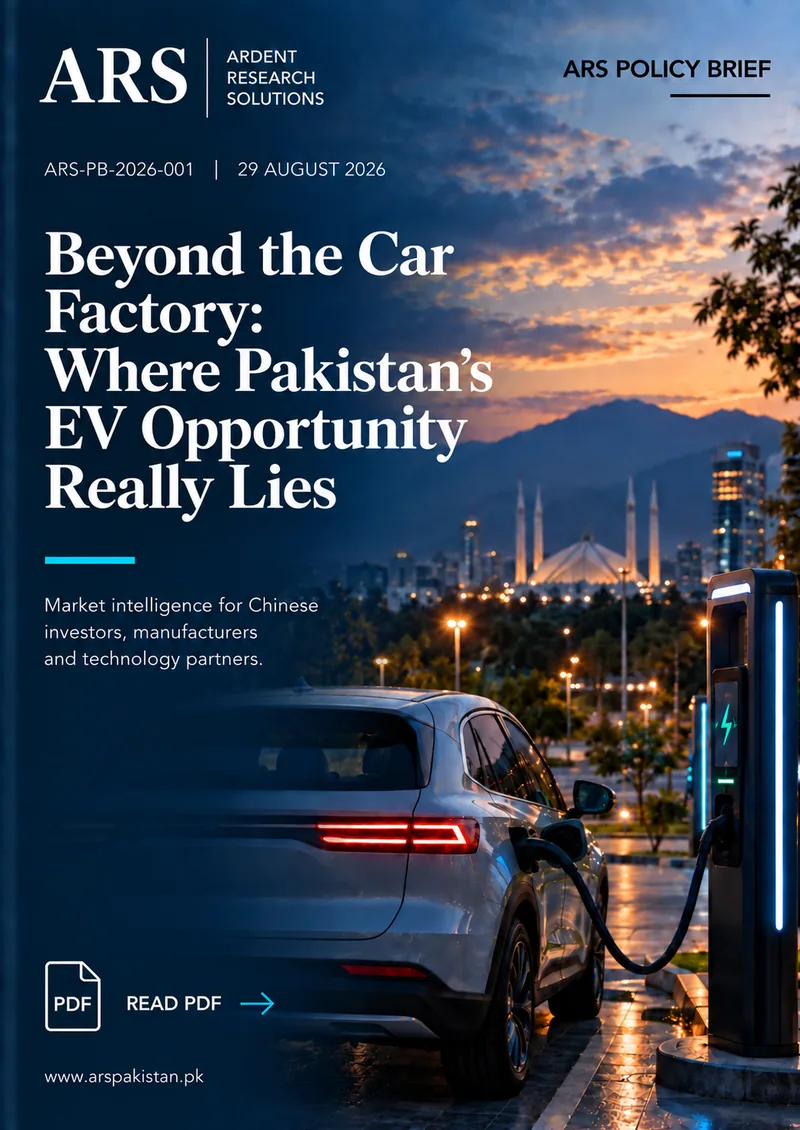
Beyond the Car Factory: Where Pakistan’s EV Opportunity Really Lies
An assessment of Pakistan's electric vehicle transition, examining investment opportunities across batteries, components, charging infrastructure, commercial mobility and two and three wheelers, with particular focus on opportunities for Chinese investors and technology partners.
Summary
Pakistan is electrifying from the bottom of the vehicle pyramid upward. This brief tests whether the country’s EV opportunity for Chinese investors is larger in batteries, components, charging, commercial mobility and two and three-wheelers than in passenger car assembly, and concludes that the thesis holds, with qualifications. The volume, the unit economics and the policy support all sit in the small vehicle and energy storage layers of the value chain, while passenger EVs remain a market of a few thousand units a year.
The brief scores Pakistan 61 out of 100 on its EV investment dashboard, in the selective entry band: attractive for targeted, capital-light positions in small vehicles and batteries, and not yet attractive for capital-intensive integrated manufacturing.
Key findings
- The mass market is electric two and three-wheelers, not cars. About 160,000 electric motorcycles have been produced locally against roughly 12,800 electric four-wheelers, and electric two-wheeler sales grew by more than 200% year on year in the first half of 2026.
- Battery pack assembly is the highest scoring opportunity, at 78 out of 100. Pakistan imported an estimated 1.25 GWh of lithium-ion packs in 2024 and faces demand of roughly 8.7 GWh by 2030 on official projections.
- Credit, not demand, has held subsidised sales back. Phase 1 of the federal vehicle electrification programme drew about 269,149 applications for 41,000 places and delivered about 5,409 vehicles, a failure of bank-side approval rather than consumer appetite.
- Charging is undersupplied but not yet bankable on its own. A subsidised station tariff of about Rs 39.70 per kWh helps, but utilisation is the constraint at present vehicle densities, so anchored models such as bus depot and fleet charging work where merchant networks do not.
- The tariff structure favours assembly over localisation, with a 1% duty on completely knocked-down kits. Cells, motors, inverters and power electronics should be assumed to remain imported for 5 years or more.
- The 2030 target is highly challenging. Reaching 30% of new vehicle sales under the NEV Policy 2025-30 implies roughly 82% compound annual growth in the new energy vehicle fleet.
- Passenger EV assembly is the least attractive point of entry for a new investor: the market is thin, the incumbent is vertically integrated and capital intensity is high.
Investment view
The brief recommends investing now in battery pack assembly for two and three-wheelers and stationary storage, in electric two and three-wheeler kit supply into the licensed assembler base, and in a captive financing capability attached to either. It advises proceeding selectively in battery swapping, where the prize is setting the standard, and in charging anchored to a fleet or an existing retail footprint; waiting on cell manufacture, motors, inverters and battery recycling; and avoiding new capital in passenger EV assembly for now.
Three policy changes would materially improve the case: a mandated or industry-agreed swappable battery standard, enactment of the lithium-ion battery policy with a multi-year, non-reversible tariff schedule, and a credit guarantee or refinancing facility that removes the bank approval bottleneck. The main risks are policy discontinuity around the 30 June 2027 expiry of current concessions, foreign exchange exposure in continuous import business models, and the reliability of electricity supply.
Inside the brief
- Executive Summary
- ARS EV Investment Dashboard
- Market Baseline: What the Numbers Actually Show
- The Policy Framework: Enacted, Funded and Pending
- Mapping the Value Chain
- Opportunity 1: Battery Packs, Cells and Storage
- Opportunity 2: Battery Swapping
- Opportunity 3: Charging Infrastructure
- Opportunity 4: Motors, Controllers and Power Electronics
- Buses, Commercial Vehicles and the Public Procurement Channel
- Two and Three-Wheelers: Pakistan’s Actual EV Mass Market
- Localisation: What Pakistan Can Realistically Manufacture
- Tariffs, Taxes and the Localisation Contradiction
- The 2030 Question, Policy Continuity and Foreign Exchange
- The Chinese Investor Landscape and the China+1 Comparison
- ARS Investment Opportunity Matrix, Watchlist and Methodology
- ARS Conclusion and Investment View
- Sources, Data Standards and Methodology
About the author
How to cite
Khan, R. (2026). Beyond the Car Factory: Where Pakistan’s EV Opportunity Really Lies. Ardent Research Solutions. https://arspakistan.pk/policy-briefs/pakistan-ev-transition.html
Related research
This summary is drawn from the full publication, which should be read for the sources, qualifications and method behind each finding. It reflects the views of the author and not necessarily those of ARS or its affiliates. This brief is research and analysis, not investment, legal or tax advice.